Memo Published March 10, 2026 · 7 minute read
The Forces Driving M&A on Main Street

Takeaways
- Most M&A activity occurs far from the headline megadeals, with small business transactions driving the bulk of deal volume.
- Small business M&A often responds to different forces than those affecting large businesses.
- Economic uncertainty accelerates deal timing and reshapes negotiations, influencing when owners sell, who buys, and how risk is allocated in transactions.
- Main Street M&A deals often support continuity, opportunity, and growth rather than market dominance.
When people think about mergers and acquisitions (M&A), they typically picture billion-dollar deals—Disney buying Fox or Exxon buying Mobil. But this misses the whole story. While mega-mergers dominate headlines and can drive overall deal value, they represent a fraction of transaction activity by deal count.
PwC called 2025 a “big-deal” year, reporting 10,333 deals worth $1.6 trillion through November 30, 2025. Only 74 of those deals were valued at $5 billion or more.1 Most deals are much smaller: BizBuySell tracked around 9,500 small business sales, with median prices around $300,000 to $350,000.2
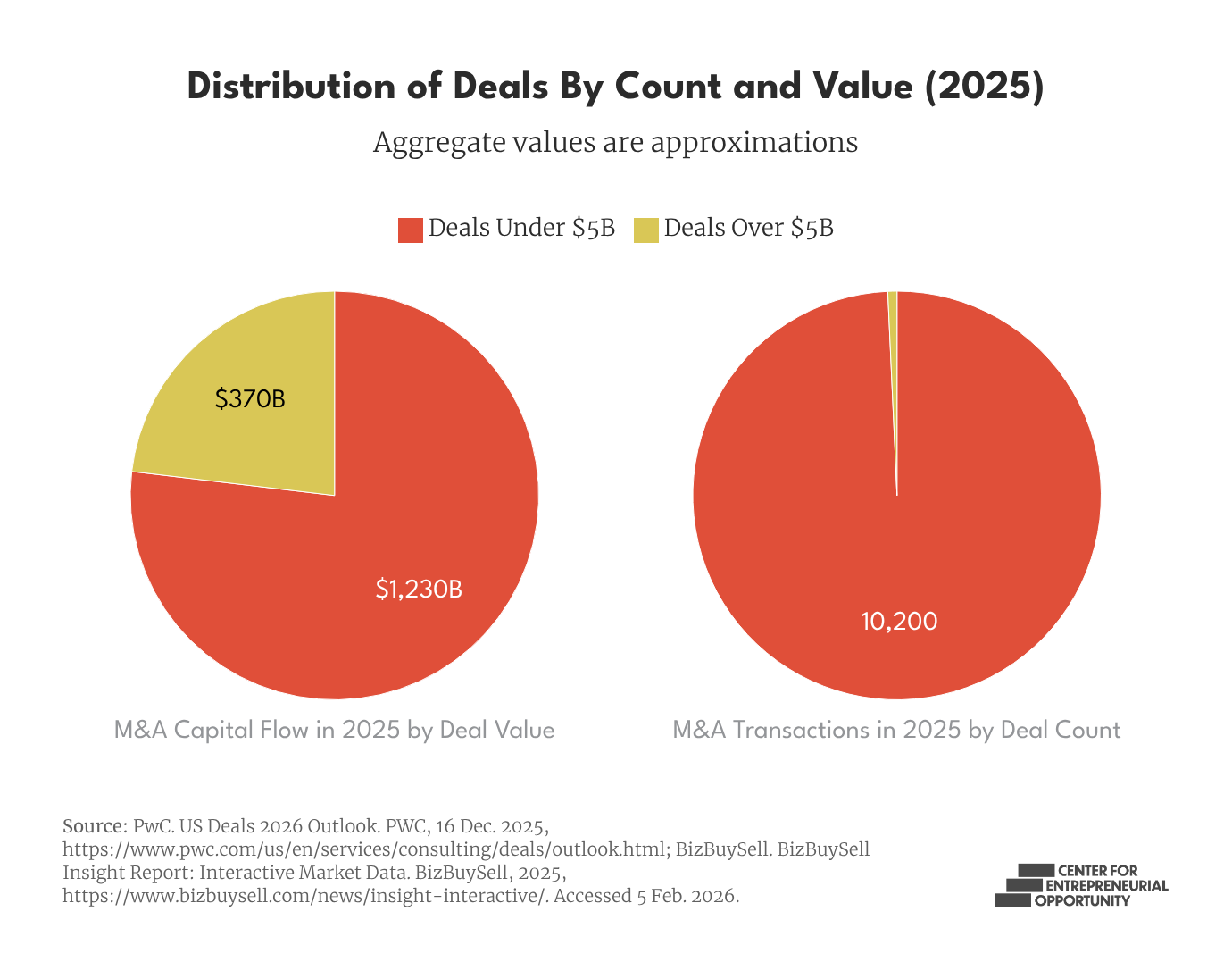
In other words: big deals drive headlines and aggregate value totals, but smaller deals drive the volume of transactions taking place across the economy—including retirements, consolidation, and competitive buyouts on Main Street.
In this report, we explore the intersection of M&A and Main Street. We unpack what drives small business deals and look into what recent data reveals about M&A trends. This background is critical for policymakers since most policy discussions treat M&A as if it were solely about corporate empire-building. As we see below, it’s time to also recognize M&A as a tool for small business owners to retire, for new entrepreneurs to buy in, and for small businesses to survive transitions.
What Drives Small Business Deals
Mergers and acquisitions are not just financial transactions—they are pivotal moments in the life of a business. For some entrepreneurs, M&A offers a faster path into ownership. For others, it provides a way to step back, retire, or pass on what they have built. Below, we look at what typically drives M&A activity on Main Street as well as some short-term costs and complexities that often accompany long-term opportunity.
On-Ramps & Off-Ramps
Mergers and acquisitions offer both an on-ramp and off-ramp for business ownership. Entrepreneurship through acquisition (ETA) lets first-time entrepreneurs buy businesses that already generate revenue rather than starting from scratch. This pathway is now supported by a budding ecosystem of advisors and lenders who specialize in helping buyers navigate deals.3
Buying an existing business requires significant investments of capital and time to identify acquisition targets, conduct due diligence, and negotiate and close a transaction. When buyers put personal assets, such as savings or home equity, towards loans for ETA, they are also putting their financial security on the line.
Conversely, M&A can serve as an exit strategy at the end of an entrepreneurial journey. A business sale can convert the company into cash, letting owners retire or pursue other endeavors. In BizBuySell’s survey of brokers, nearly half reported that Baby Boomers made up the majority of their listings—underscoring retirement as a motivation for selling a small business.4 As an exit strategy, a business sale or other ownership transition is critical to enabling business continuity, preserving jobs and community wealth.
Business Viability and Growth
M&A can also enable a business to refocus its investments or stabilize operations by achieving cost advantages that come with scale. This includes negotiating better supplier rates or spreading fixed costs across more customers. Adding capacity through acquisition can be critical in industries facing thin margins and cost pressures.
Further, M&A allows businesses to expand market share, geographic reach, or diversify offerings by adding new capabilities. For example:
- An HVAC installer may acquire a plumbing business to broaden its home-services portfolio.
- A regional landscaping company may acquire a competitor in a neighboring area to expand their footprint.
- A merger between an architectural firm and a general contractor can enable design-build capabilities and access to larger, higher-margin projects.
By expanding a customer base and product offerings, businesses can leverage M&A as a risk mitigator. For example, AmeriLux—a plastic sheets distributor—acquired a manufacturer that enabled the company to pivot during COVID to produce hygiene barriers, supporting business continuity amid disruption.5
Short-Term Costs, Long-Term Gains
Mergers and acquisitions involve upfront costs—legal fees, due diligence, and financing—that can weigh on short-term performance. Businesses may also face temporary operational disruptions as systems are integrated. Depending on how the purchase is financed, the business may carry new loan payments, or the owner may have to share ownership with outside investors. These short-term frictions help distinguish small M&A transactions from megadeals and make Main Street transactions particularly sensitive to policy design and financing conditions.
The financial benefits of combining two businesses may take time to materialize. Early gains tend to come from modest cost savings, such as eliminating duplicative administrative functions. Over the longer term, businesses can expand their market share or geographic reach and make better use of physical assets, leading to revenue growth and better profit margins. These gains can, in turn, enhance access to capital, enabling new investments—such as those in marketing, recruitment, and employee training.
What the Data Tells Us
In order to understand what drove small business M&A activity in 2025, we examined BizBuySell’s quarterly Insight Reports (which track Main Street transactions) along with broader trends from PwC's 2026 Market Outlook and Cornerstone Business Services.6 Together, these sources highlight how economic volatility, labor market shifts, and sector-specific pressures are influencing M&A activity.
Activity is Largely Influenced by Economic Uncertainty
In 2025, uncertainty drove many small business owners to sell sooner rather than wait for better prices.7 Activity was soft in early quarters as inflation weighed on confidence, then picked up in the third and fourth quarters.8 By the third quarter, 60% of surveyed owners worried that waiting until 2026 would bring the same or even lower sale prices.9 By the end of the year, roughly one-quarter of planned sellers cited economic uncertainty as a key motivator.10
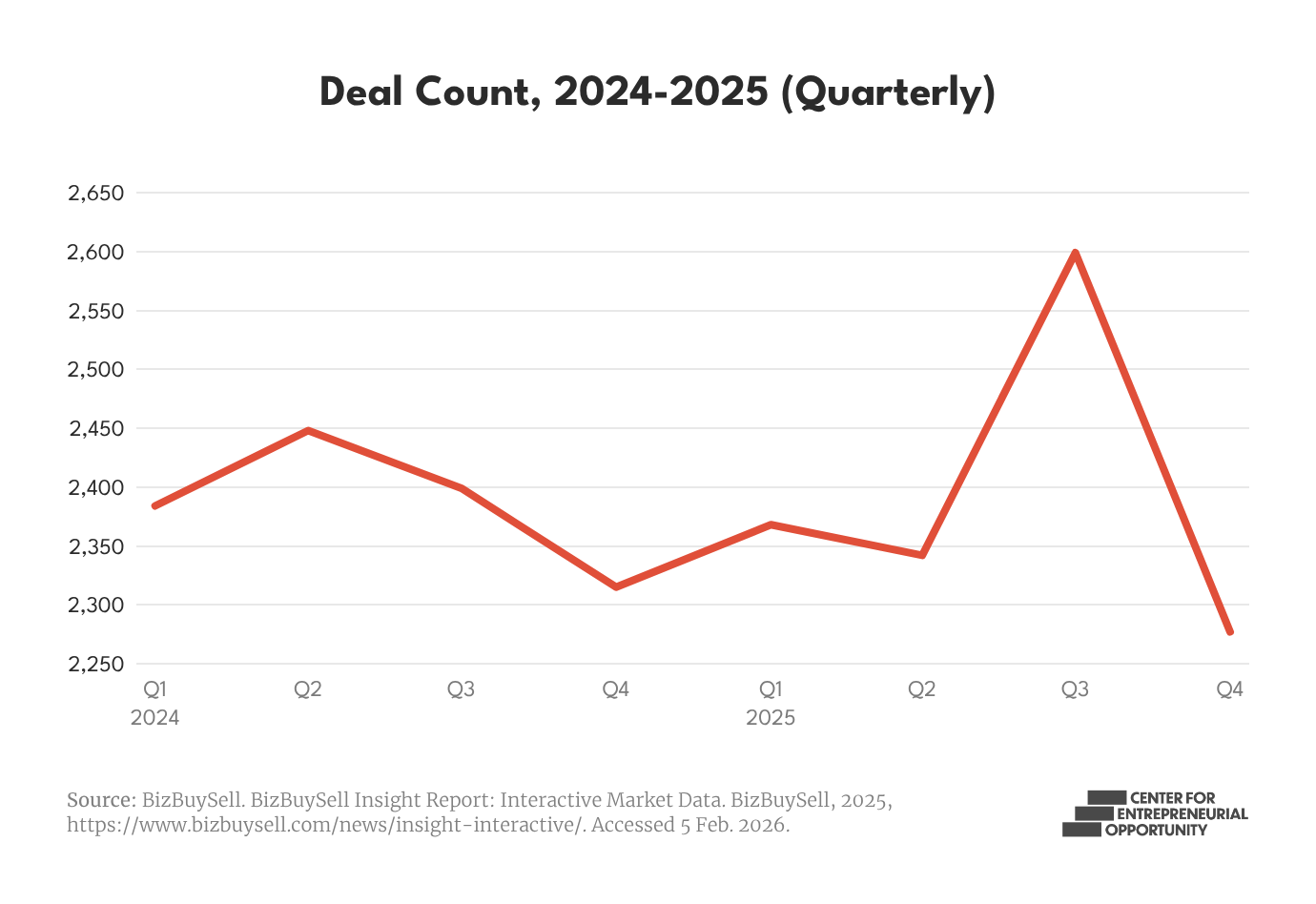
Rising costs also squeezed margins. From the second through third quarter, median sale prices fell 9% and cash flow declined 6%.11 Sale prices later stabilized, ending the year up 2%.12 As one business advisor observed, buyers have become “more cautious and deliberate” amid inflation, tariffs, and immigration-related concerns—prompting more rigorous diligence and greater attention to risk in deal terms.13
Taken together, the 2025 data suggests that uncertainty is shaping both when owners decide to sell and how small-business transactions are negotiated.
Many Are Turning to Entrepreneurship Amidst a Slowing and Shifting Job Market
Entrepreneurship through acquisition is increasingly shaped by a shifting job market, as workers turn to buying and running an existing small business as an alternative to traditional employment. BizBuySell found that 40% of business buyers identified as “corporate refugees,” leaving salaried jobs for business ownership. Among brokers, 43% reported increased activity from MBA graduates pursuing ETA. Among self-identified corporate refugees, 28% noted concerns about AI replacing jobs which influenced their decision to leave corporate life for business ownership.
BizBuySell also emphasizes how deal activity in this market segment is often driven by personal and practical considerations—such as business performance, buyer readiness, and personal timelines—more than by “interest-rate chatter” in the news cycle.14 Overall, ETA functions as both a pathway to ownership and a response to job market disruption.
Sectoral Differences Track with Macroeconomic Trends
M&A dynamics are not uniform across sectors. In 2025, the manufacturing sector saw an 11% decline in transactions alongside a 7% decline in median sale price, reflecting trade uncertainty, ongoing supply chain disruptions, and rising costs.15 Meanwhile, financial services, technology services, and architectural and engineering services saw stronger activity, with higher transaction volumes and prices.16 Larger deals tracked by PwC also showed rising demand for tech capabilities including, AI, cybersecurity, and semiconductors.
Overall, the evidence shows that small business M&A operates under fundamentally different conditions than headline-garnering megadeals—serving as a mechanism for ownership transition, adaptation, and continuity.